narrative: SAVVI FIND
Version: Version 1
Created: 1 December 2025
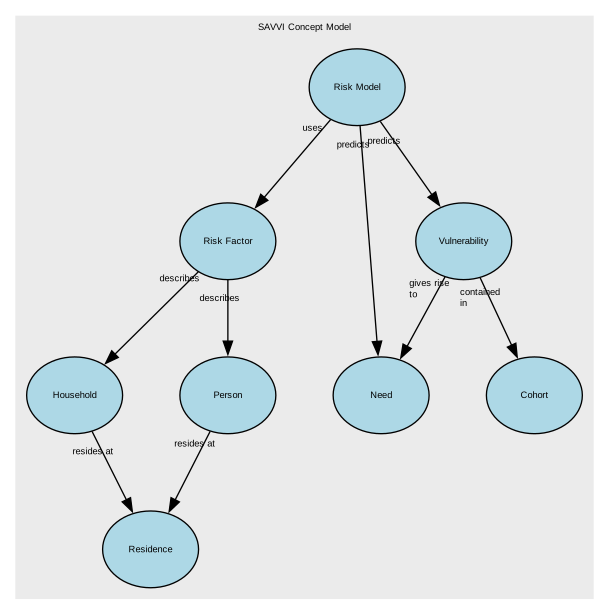
A vulnerability initiative will establish a RISK MODEL for a VULNERABILITY, which sets out the rules by which RISK-FACTORS will be used to generate and prioritise a COHORT of PERSONs or HOUSEHOLDs with potential NEEDs.
Renditions
| Format | Link |
|---|---|
| Graphviz DOT | dot.txt |
| DSD JSON | dsd.json |
Index
Concepts from SAVVI Concept Model
| Concept | Description |
|---|---|
| Cohort | An initial prioritised list of people and households that may have a risk of a VULNERABILITY. |
| Household | A collection of PERSONs who live together at the same RESIDENCE and function as a social unit. |
| Need | An unmet requirement of a Person or Household that can be addressed. |
| Person | An Individual who may be vulnerable. |
| Residence | A home of a PERSON |
| Risk Factor | A single fact about a Person or Household that can be combined with others to categorise the risk of a VULNERABILITY , and predict NEEDs. |
| Risk Model | The rules by which RISK FACTORs will be used to prioritise VULNERABILITY risk, and predict NEEDs. |
| Vulnerability | The increased risk of a poor outcome. |
Links from SAVVI Concept Model
Concepts
Cohort
Concept Model: SAVVI Concept Model
An initial prioritised list of people and households that may have a risk of a VULNERABILITY.
Notes:
This is the result of running the RISK MODEL, so that only people or households that meet a minimum risk category are listed and prioritised.
Links:
Household
Concept Model: SAVVI Concept Model
A collection of PERSONs who live together at the same RESIDENCE and function as a social unit.
Notes:
see definition https://dictionary.cambridge.org/dictionary/english/household
Note the ONS definition
One person living alone, or a group of people (not necessarily related) living at the same address who share cooking facilities and share a living room, sitting room or dining area.
Note the Individualised Learner Record definition
A household is defined as a housekeeping unit or, operationally, as a social unit:
- Having common arrangements;
- Sharing household expenses or daily needs;
- In a shared common residence.
A household includes either one person living alone or a group of people, not necessarily related, living at the same address with common housekeeping, i.e. sharing at least one meal per day or sharing a living or sitting room.
Links:
- Household → HouseholdHasResidence → Residence
- Risk Factor → RiskFactorDescribesHousehold → Household
Need
Concept Model: SAVVI Concept Model
An unmet requirement of a Person or Household that can be addressed.
Notes:
Examples of NEEDs include
secure housing
managing debt
ensure take up of benefits
to be evacuated during a flood The Supporting Families programme lists 34 NEEDs including
parenting support
support with their finances
achieve at least 90% school attendance
Links:
Person
Concept Model: SAVVI Concept Model
An Individual who may be vulnerable.
Links:
Residence
Concept Model: SAVVI Concept Model
A home of a PERSON
Links:
Risk Factor
Concept Model: SAVVI Concept Model
A single fact about a Person or Household that can be combined with others to categorise the risk of a VULNERABILITY , and predict NEEDs.
Notes:
Examples of RISK FACTORs include
- Lives Alone
- has a Blue Badge
- has Rent Arrears
- Not Registered with a GP
- No Adult in Household in Employment RISK FACTORs can also be ‘protective’ - that is, information that demonstrates that a risk is reduced, or is already being managed.
A RISK-FACTOR is a type of ATTRIBUTE so that it can be represented as a single fact about a Person or Household; preferably boolean but could have a single value that can be acted on in a Rules Engine.
ATTRIBUTEs support data-minimisation so that only the necessary information is passed, using a precise definition.
ATTRIBUTEs are also useful for other uses such as establishing eligibility for a Service.
Links:
- Risk Factor → RiskFactorDescribesHousehold → Household
- Risk Factor → RiskFactorDescribesPerson → Person
- Risk Model → RiskModelUsesRiskFactor → Risk Factor
Risk Model
Concept Model: SAVVI Concept Model
The rules by which RISK FACTORs will be used to prioritise VULNERABILITY risk, and predict NEEDs.
Notes:
RISK FACTORS can be combined and weighted to identify and categorise people and households who may have a VULNERABILITY, and predict NEEDs.
Risk Models should be based on evidence and studies, and will be continually improved by learning.
Links:
- Risk Model → PredictsNeed → Need
- Risk Model → PredictsVulnerabilty → Vulnerability
- Risk Model → RiskModelUsesRiskFactor → Risk Factor
Vulnerability
Concept Model: SAVVI Concept Model
The increased risk of a poor outcome.
Notes:
VULNERABILITYs might include
becoming homeless
being unsafe during adverse weather such as a flood
children disadvantaged by poverty The Supporting Families programme call these “Headline Outcomes”, with examples such as
getting a good education
children safe from abuse and exploitation
Links:
- Vulnerability → CohortContainsVulnerability → Cohort
- Vulnerability → NeedArisesFromVulnerability → Need
- Risk Model → PredictsVulnerabilty → Vulnerability
Links
CohortContainsVulnerability
From: Vulnerability
Label: contained in
To: Cohort
Concept Model: SAVVI Concept Model
HouseholdHasResidence
From: Household
Label: resides at
To: Residence
Concept Model: SAVVI Concept Model
NeedArisesFromVulnerability
From: Vulnerability
Label: gives rise to
To: Need
Concept Model: SAVVI Concept Model
PersonResidesAt
From: Person
Label: resides at
To: Residence
Concept Model: SAVVI Concept Model
PredictsNeed
From: Risk Model
Label: predicts
To: Need
Concept Model: SAVVI Concept Model
PredictsVulnerabilty
From: Risk Model
Label: predicts
To: Vulnerability
Concept Model: SAVVI Concept Model
RiskFactorDescribesHousehold
From: Risk Factor
Label: describes
To: Household
Concept Model: SAVVI Concept Model
RiskFactorDescribesPerson
From: Risk Factor
Label: describes
To: Person
Concept Model: SAVVI Concept Model
RiskModelUsesRiskFactor
From: Risk Model
Label: uses
To: Risk Factor
Concept Model: SAVVI Concept Model